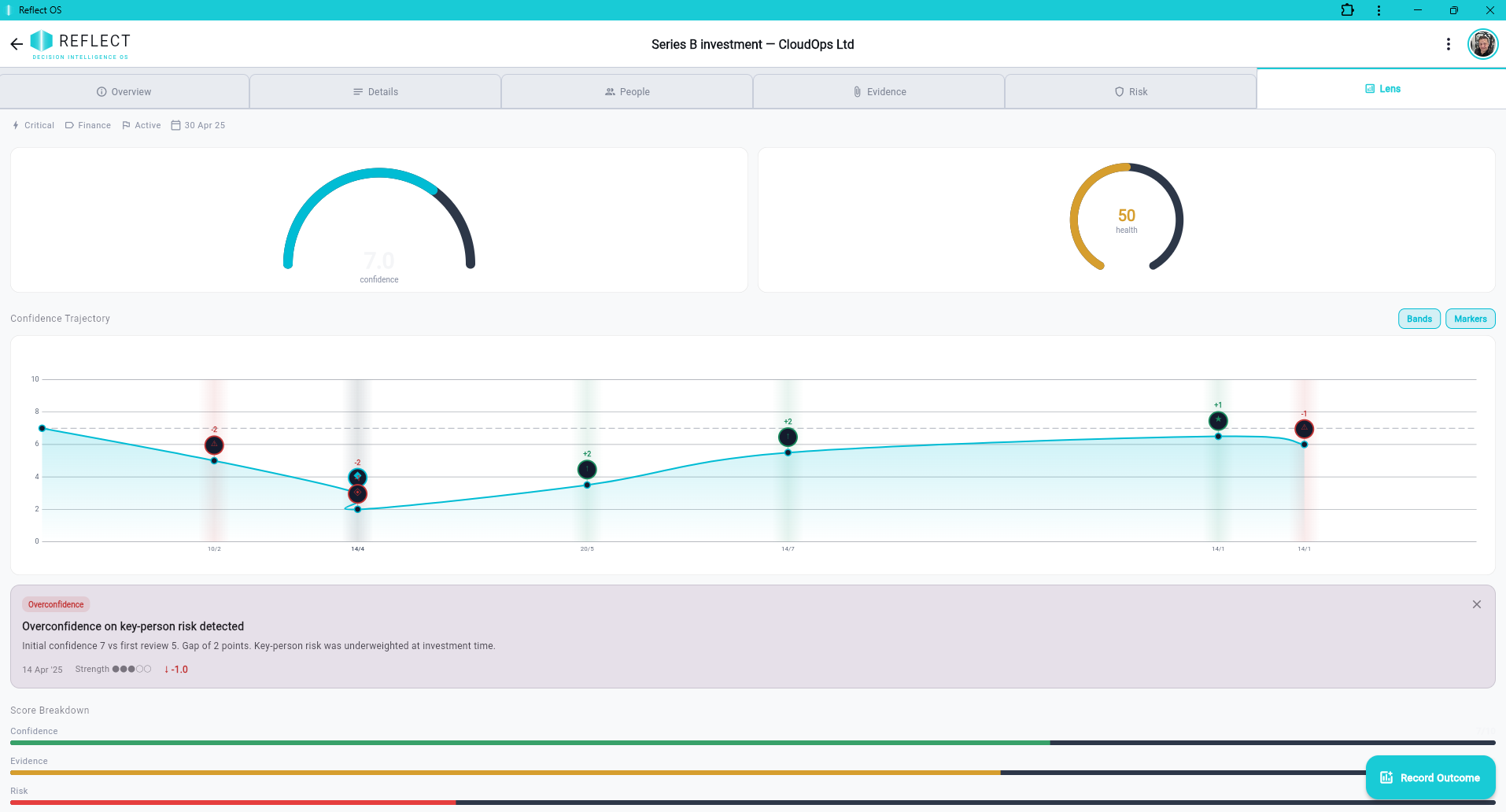
Confidence calibration across your deal history — see exactly where thesis quality breaks down
You're judged on decision quality over multi-year horizons, not daily task completion. Reflect OS is the infrastructure layer that makes your IC process a compounding asset.
Reflect OS gives investment teams a structured system to log IC decisions with full rationale, track confidence calibration across the portfolio, and run automatic 30/90/180-day outcome reviews. Over time it reveals where the team is well-calibrated and where systematic biases are costing returns.
Past IC rationale is scattered across decks, emails, and meeting notes. Reflect OS creates a single structured record of what was believed, what was debated, and what was decided.
It becomes unclear whether outcomes were driven by the original thesis, execution changes, or macro conditions. Reflect OS links outcomes back to the exact logic captured at decision time.
Overconfidence in a sector, narrative fallacy, recency bias — these go unmeasured because nobody tracks the pattern across deals. Reflect OS makes the pattern visible.
Investment outcomes are inherently multi-year. Reflect OS handles the ambiguity — keeping decisions in review with partial outcome states until the full picture emerges.
The same diligence gaps repeat because there's no structured post-mortem library. With Reflect OS, every completed investment becomes a searchable reference for the next one.
Memos are written for approval, not for learning. Reflect OS captures what the memo doesn't — the doubts, the near-misses, the signals that were discounted and shouldn't have been.
Confidence calibration across your deal history — see exactly where thesis quality breaks down
Thesis, upside case, downside case, key risks, disconfirming evidence — all pre-structured. Every deal captured consistently, so comparison across your portfolio is actually meaningful.
6, 12, 24-month checkpoints — with "still unrealised" handling for decisions where the outcome isn't in yet. No forced closure. Decisions stay in review until the full picture is clear.
Compare your decision quality and calibration scores against anonymised peer cohorts. Launching in v1.1 once the user base reaches the minimum size needed for statistically meaningful benchmarks.
"Every fund cycle we'd lose the thread on why we passed. Reflect OS means we don't have to reconstruct. The IC rationale is there, exactly as we wrote it."
Every investment decision is a hypothesis. You believe a company will grow, a market will expand, or a founder will execute. You assign a probability — implicitly or explicitly — and commit capital. The quality of your investment process is not measured by any single outcome. It is measured by the accuracy of your hypotheses across dozens or hundreds of decisions over years.
Reflect OS gives investment professionals the infrastructure to track those hypotheses systematically: the thesis at the time of investment, the confidence level, the expected milestones, and the actual outcomes. Over time, this produces a precise picture of where your judgement is strong and where it is not.
Most investment teams have a deal memo process. What they rarely have is a systematic review process. Reflect OS closes that loop. When a decision is logged — whether a seed investment, a follow-on round, or a portfolio intervention — it enters a structured review cycle with scheduled checkpoints at 6, 12, and 24 months.
At each checkpoint, the investment team records what actually happened versus what was projected. Confidence scores are updated. Lessons are captured. Over time, the portfolio becomes a learning system rather than just a financial asset.
Investment outcome tracking: Reflect OS supports investment-specific outcome states — Unrealised, Partial, Realised, and Written Off — alongside standard quality scores. This maps precisely to the realities of long-horizon investment decisions.
Risk assessment integration: Every investment decision can include a structured risk assessment using the ISO 31000 framework. AI-generated risk identification surfaces factors you may have underweighted, with each risk scored by likelihood and impact.
IC pack support: Decisions can include structured IC pack documentation, committee voting records, and approval workflows. The entire investment process — from initial screening to IC approval to outcome review — is captured in one place.
Portfolio-level intelligence: Across your portfolio, Reflect OS identifies patterns in your decision quality. Which sectors have you consistently overestimated? Which founder profiles have delivered above expectations? Which risk factors were systematically underweighted? These insights compound in value as your portfolio grows.
Investment decisions are among the most sensitive data an organisation holds. Reflect OS encrypts all decision content — rationale, context, outcome notes — at rest using AES-256 encryption. Encrypted fields are never used to train AI models and are never searchable, even within your own team. Only you can decrypt your investment decision record.
Most investment teams make decisions in consistent ways — sector focus, stage preference, check size range — but very few have a formally documented investment decision framework that captures and enforces consistency across the team. The consequence is that new partners bring different standards, IC debates recycle the same unresolved questions, and the team cannot distinguish between "we passed on this because it didn't meet our criteria" and "we passed on this because someone was in a bad mood that day."
A repeatable investment decision framework has four components:
Reflect OS provides the infrastructure for all four components: structured templates enforce documentation consistency, the decision log timestamps and locks IC rationale at the point of decision, and the review system prompts the team at the right intervals and captures outcomes in a format that enables portfolio-level analysis.
Not every interaction with a portfolio company warrants a structured decision log. The four decision types with the highest signal value are:
Reflect OS structures portfolio reviews around a 30/90/180-day cadence that maps to the information curve after an investment decision:
For longer-horizon decisions, the 30/90/180 cadence extends naturally into annual and 24-month reviews. The structured review notes from 30 and 90 days feed directly into the annual LP reporting cycle.
The Decision Lens in Reflect OS — confidence trajectory and overconfidence patterns surfaced across portfolio decisions.
The portfolio decision review process is where investment frameworks compound in value. Without it, the IC memo is an approval document — written for the committee, not for learning. With it, the IC memo becomes the baseline for a structured feedback loop that runs for the life of the fund.
An effective portfolio decision review process has three phases:
At 6 and 12 months post-investment, the deal lead reviews the original IC memo and answers three questions: Which assumptions have been confirmed? Which have been refuted? Which remain uncertain? This is not a performance review — it is a thesis review. The goal is to understand whether the original investment rationale is tracking as expected, not just whether the company is growing.
At 24 months, the review moves from thesis tracking to attribution. If the investment is performing well, what is driving it — the original thesis, factors not anticipated in the memo, or macro tailwinds? If it is underperforming, which assumptions failed? Attribution analysis is the key to improving future investment decisions: it distinguishes skill from luck in both the positive and negative directions.
Across the portfolio, Reflect OS aggregates confidence scores and outcome data to generate calibration curves by sector, stage, and partner. This is the layer of analysis that most fund managers have never had access to: empirical data showing where the team's collective judgment is well-calibrated and where it systematically overestimates or underestimates outcomes. For a fund preparing for its next raise, this data is a compelling differentiator — a data-backed account of how and why the team's decision quality has improved across the fund cycle. For more on how investment managers use decision intelligence, see our guide on decision intelligence for investment management and our investment committee best practices.
Investment decisions contain your most sensitive thinking. Reflect OS encrypts decision rationale and sensitive fields at rest. We do not use your decision data for model training. Full details on our security page.